
Crop Yield Estimation from Satellite Data: Methods, Accuracy, and Limitations
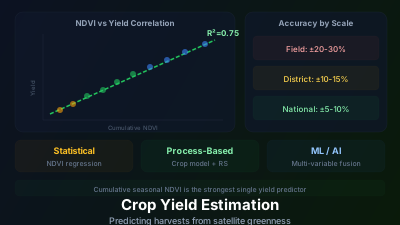
Quick Answer: Satellite-based yield estimation exploits the relationship between cumulative vegetation greenness (NDVI/EVI integrated over the growing season) and final grain yield. Simple regression against historical yields is the baseline; process-based crop models assimilating satellite LAI generally do better, at the cost of far more input data. Accuracy improves with larger spatial aggregation for both approaches — field-level estimates carry the largest error, because management decisions the satellite cannot see (variety, fertilizer timing, pest control) dominate at that scale and average out at regional and national scale. Yield estimation works best for grain crops (wheat, corn, rice) in uniform landscapes and degrades in smallholder, mixed-cropping systems.
The clearest argument for satellite yield estimation is what happens when the usual reporting chain breaks. Official crop statistics are built from field surveys, farmer returns, and administrative reporting — all of which stop working in a conflict zone, after a disaster, or wherever a government lacks the capacity to collect them. Satellites keep observing regardless. That is the strategic value: the method works at scale, arrives before the harvest is counted, and requires no physical access to the fields.
The Fundamental Relationship
Crop yield depends on how much sunlight a plant intercepts and converts to biomass during the growing season. Satellite vegetation indices — NDVI, EVI, LAI — measure the green leaf area, which directly relates to light interception capacity.
The connection:
- More green leaves → more light intercepted → more photosynthesis → more biomass → more grain
- Satellite NDVI tracks green leaf area through the season
- Integrated NDVI (sum or average over the growing season) correlates with total biomass production
- Harvest index (the fraction of biomass that becomes grain) converts biomass to yield
This chain of relationships means that cumulative seasonal NDVI is a useful predictor of yield — not perfect, but meaningful enough for operational forecasting.
Statistical Approaches
Simple Regression
The most straightforward method: regress historical yield data against satellite-derived vegetation metrics.
Typical predictors:
- Peak NDVI during the growing season
- Mean NDVI during a critical growth window (e.g., grain fill period)
- Cumulative NDVI (sum of all NDVI values across the season)
- Date of peak NDVI (phenological indicator)
Typical performance: the fit improves consistently with the scale of aggregation — weakest for individual fields, better at district or county level, best at provincial or state level. The absolute R² values reported vary widely between studies with the crop, the region, and the length of the yield record, so take them from a study covering your own system rather than from a general range.
The improvement with spatial aggregation occurs because individual field yields are affected by management factors (variety choice, fertilizer timing, pest control) that satellites can't detect. At larger scales, these field-level variations average out, leaving the weather-driven signal that satellites capture well.
Machine Learning
Random Forest, gradient boosting, and neural networks can model non-linear relationships between satellite metrics and yield, incorporating additional variables:
- Weather data (temperature, precipitation)
- Soil properties
- Historical yield trends
- Multi-temporal vegetation index features
These models generally fit better than simple regression, and the margin is widest where environmental variability is high — but the size of the improvement depends on the crop, the region and the length of the yield record, so it has to be measured against your own held-out seasons.
Process-Based Approaches
Crop simulation models (DSSAT, APSIM, WOFOST) simulate daily crop growth based on weather, soil, and management inputs. They produce yield estimates grounded in plant physiology rather than statistical correlations.
Satellite data assimilation improves these models by:
- Running the model with estimated input parameters
- Comparing simulated LAI/biomass with satellite-observed values
- Adjusting model parameters (planting date, soil water, nitrogen) to minimize the mismatch
- Re-running the model with calibrated parameters to forecast yield
This data assimilation approach combines the physical realism of crop models with the spatial coverage of satellite observations. Its error follows the same scale pattern as the regression approach — largest at field level, smaller for regional aggregates — and depends heavily on the quality of the weather, soil, and management inputs the model is driven with. As with regression, read the validation published for the specific model and region rather than assuming a general figure.
What Works and What Doesn't
Works Well
- Grain crops (wheat, corn, rice, barley): Strong relationship between canopy greenness and grain yield
- Uniform landscapes: Large fields, mechanized agriculture, consistent management
- Season-to-season variation: Years with good conditions (high NDVI) produce high yields; drought years (low NDVI) produce low yields
Works Poorly
- Root/tuber crops (potato, cassava): Yield is underground; aboveground biomass is a weaker predictor
- Smallholder systems: Small fields, mixed cropping, variable management — satellite pixels capture a mix of crops and practices
- Irrigated systems under consistent management: When water and nutrients are never limiting, NDVI is always high, and yield variation is driven by factors (disease, heat stress during flowering) that NDVI misses
- Extreme events: Heat waves during flowering can devastate yield without reducing NDVI if they're brief. The crop looks green but the grain fill was impaired.
Timing of Forecasts
The value of a yield forecast depends on when it's available:
| Forecast Time | Data Available | Accuracy | Utility |
|---|---|---|---|
| Pre-season (3+ months before harvest) | Historical NDVI + weather forecasts | Lowest — the season has not happened yet | Long-range planning |
| Mid-season (peak growth) | Current-year NDVI during vegetative stage | Improving — canopy formed, grain fill still ahead | Market positioning |
| Late-season (grain fill) | Near-complete NDVI time series | Good — most yield-determining stages observed | Logistics planning |
| Post-harvest | Complete season data | Best — nothing left to forecast | Statistical verification |
The practical challenge: the most accurate forecasts come after the information is most needed. Commodity traders want yield estimates in June for a September harvest; the satellite data is most predictive in August.
Operational Systems
Several organizations produce operational satellite-based yield forecasts:
USDA Foreign Agricultural Service (FAS): Produces monthly crop condition reports for major agricultural countries using MODIS and Landsat data. The World Agricultural Outlook Board (WAOB) integrates these into USDA supply/demand estimates.
European Commission MARS: The Monitoring Agricultural ResourceS program uses Sentinel-2 and weather data to forecast yields across the EU, publishing monthly crop yield bulletins.
FAO GIEWS: The Global Information and Early Warning System monitors food production worldwide, using satellite data to identify countries at risk of food shortfalls.
GEOGLAM Crop Monitor: A G20 initiative providing consensus crop condition assessments for major producing regions.
Crop-Specific Accuracy Reference
Which satellite signal works best, and how far you can trust it, varies substantially by crop. The pattern is driven by where the yield actually sits relative to what the sensor can see:
| Crop | Best Satellite Predictor | Relative Reliability | Key Challenge |
|---|---|---|---|
| Winter wheat | Cumulative NDVI over the spring growth window | Among the best | Green-up timing confounds with soil type |
| Rice (paddy) | SAR VH polarization (flooding + vegetation) | Good; SAR sidesteps monsoon cloud | Double-crop confusion; the water signal complicates the series |
| Corn / Maize | Peak EVI + mid-season LAI | Good | Heat stress during silking barely shows in NDVI |
| Sugarcane | NDVI + NDWI seasonal arc | Moderate | Multi-year crop; harvest creates gaps in the seasonal arc |
| Soybean | NDVI through the reproductive stages | Moderate | Rapid canopy change makes results highly sensitive to acquisition timing |
| Sunflower | EVI peak + senescence timing | Moderate to poor | Short season limits time-series density |
| Potato | SAR backscatter + red-edge NDVI | Poorest of this set | Yield is underground; canopy saturates early |
When ground data disappears: Ukraine's 2022 harvest is the case most often cited. With survey access largely impossible under active conflict, satellite-based systems continued to produce area and yield estimates through the season, and those estimates were broadly consistent with the production figures that later emerged. The general lesson is the one worth carrying: satellite yield estimation degrades gracefully when ground data is unavailable rather than failing outright, because its inputs — planted area, canopy development, and weather — are observed independently of any reporting chain. Specific accuracy claims for a particular season should be taken from the issuing agency's own published assessment, since each system revises its estimates through the season and against different official baselines.
Practical accuracy benchmark: what counts as "good enough" depends entirely on the decision. National-level forecasts influence trade policy and market positioning, and there the tolerable error is tight. Field-level estimates carry much wider error bars — wide enough to be useful for portfolio-level crop insurance risk assessment, where errors average out across many fields, but not for advising an individual farmer about an individual field. Reporting a field-level estimate with the confidence appropriate to a national one is the most common way these systems are misused.
From Research to Practice
The gap between research accuracy and operational utility is real. Research papers report R² values and RMSE under controlled conditions. Operational systems must deal with:
- Missing data (cloud cover during critical windows)
- Delayed data delivery (processing and quality control take time)
- Changing crop varieties (new high-yield varieties may break historical NDVI-yield relationships)
- Policy and market sensitivity (inaccurate forecasts can move commodity prices)
Despite these challenges, satellite-based yield estimation has become an indispensable tool in global food security monitoring. It doesn't replace ground-based crop reporting — it complements it, providing spatial detail and independent verification that ground surveys alone cannot achieve.
The technology has matured to the point where the limiting factor is rarely the satellite data itself, but rather the ground truth, agronomic context, and institutional capacity to integrate satellite information into decision-making.

Remote sensing specialist with 10+ years in satellite data processing and AI. Founder of Off-Nadir Lab. Ph.D. in Informatics (Yokohama National University, 2026). Master's in Earth System Science and Technology (Kyushu University). Co-author, Remote Sensing Encyclopedia. More about the author →