
Water Quality Monitoring from Satellites: Turbidity, Chlorophyll, and Harmful Algal Blooms
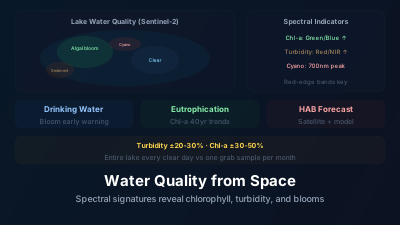
Quick Answer: Satellites estimate inland water quality by measuring how water color changes with dissolved and suspended constituents. Turbidity (suspended sediments) increases reflectance in red and NIR bands. Chlorophyll-a (algae) absorbs blue and red light, increasing green reflectance. Harmful cyanobacterial blooms show a distinctive peak near 700nm detectable by Sentinel-2's red-edge bands. Sentinel-2's 10-20m resolution maps water quality at meaningful spatial scales for lakes and reservoirs. Accuracy: turbidity ±20-30%, chlorophyll-a ±30-50% (inland waters are harder than oceans due to complex optics). Applications include drinking water source protection, eutrophication monitoring, and recreational water safety.
Lake Erie's western basin turns vivid green every summer as cyanobacterial blooms fueled by agricultural nutrient runoff cover hundreds of square kilometers. In 2014, the bloom contaminated Toledo, Ohio's drinking water supply, affecting 500,000 people. Today, satellite monitoring tracks the bloom's development weekly, providing advance warning to water utilities and public health agencies.
This is water quality monitoring at its most consequential — satellite data directly informing decisions that protect human health.
What Satellites Can Measure in Water
Turbidity / Total Suspended Matter (TSM)
Suspended particles (sediment, organic matter) scatter light, increasing water reflectance in red and NIR bands:
- Clean water: Low reflectance across all visible bands; dark in NIR
- Turbid water: Elevated reflectance, especially in red (620-670 nm) and NIR
Simple band ratios (Red/Blue, or Red/Green) provide robust turbidity estimates. The relationship is well-established and reasonably linear up to moderate turbidity levels.
Chlorophyll-a (Phytoplankton/Algae)
Chlorophyll pigments absorb blue (~440 nm) and red (~670 nm) light while scattering green light:
- Low chlorophyll: Water appears blue (clear, oligotrophic)
- High chlorophyll: Water appears green (eutrophic, algal bloom)
The ratio of green to blue reflectance is the simplest chlorophyll indicator. More sophisticated algorithms use the red-edge region (700-720 nm) where chlorophyll fluorescence creates a reflectance peak detectable by Sentinel-2's B5 (705 nm) band.
Cyanobacteria (Blue-Green Algae)
Cyanobacteria contain phycocyanin, a pigment that absorbs orange light (~620 nm) and produces a distinctive spectral signature:
- Absorption trough near 620 nm
- Fluorescence peak near 650 nm
- Scattering peak near 700 nm
Sentinel-2's band configuration (B4 at 665nm, B5 at 705nm) captures the 700nm peak, enabling discrimination of cyanobacteria from other algae. This discrimination matters because cyanobacteria produce toxins (microcystins) that other algae don't.
Colored Dissolved Organic Matter (CDOM)
CDOM absorbs strongly in blue and UV wavelengths, giving water a yellow-brown appearance:
- High CDOM reduces blue reflectance
- Common in waters receiving forest or wetland runoff
Secchi Depth / Water Clarity
The depth at which a white disk becomes invisible — a traditional water clarity measure — correlates with satellite-derived reflectance in blue and green bands. Empirical relationships between satellite reflectance and Secchi depth enable mapping of water clarity across entire lakes.
Sentinel-2 for Inland Water Quality
Sentinel-2 has transformed inland water quality monitoring:
Spatial resolution: 10-20m resolves water quality variation within lakes and reservoirs — sediment plumes from tributaries, algal bloom patches, mixing zones.
Spectral bands: The red-edge bands (B5, B6, B7) at 705, 740, and 783 nm are particularly valuable for high-chlorophyll waters where standard blue-green algorithms saturate.
Revisit: 5-day revisit provides temporal resolution sufficient for tracking bloom development and sediment transport events.
Free and open: No data cost barrier for operational monitoring programs.
Atmospheric Correction Challenge
Inland water quality remote sensing faces a more severe atmospheric correction challenge than ocean color:
- Water signals are weak (water is dark)
- Adjacent land surfaces contaminate pixels near shorelines ("adjacency effect")
- Standard atmospheric correction algorithms optimized for land may over-correct water pixels
Specialized processors (ACOLITE, C2RCC, iCOR) designed for aquatic applications produce better results than generic atmospheric correction for water pixels.
Algorithms
Empirical Algorithms
Simple band ratios calibrated against field measurements:
- Chlorophyll-a: Green/Blue ratio, Red-edge/Red ratio
- Turbidity: Red band reflectance, Red/Green ratio
- CDOM: Blue/Green ratio (inverse)
These are site-specific — calibrated for one lake, they may not transfer directly to another with different optical properties.
Semi-Analytical Algorithms
Physics-based models that decompose the water reflectance signal into contributions from chlorophyll, suspended matter, and CDOM:
- C2RCC (Case 2 Regional Coast Colour): Implemented in SNAP software; uses neural networks trained on radiative transfer simulations
- QAA (Quasi-Analytical Algorithm): Derives absorption and backscattering coefficients from reflectance
These algorithms are more transferable across different water bodies than empirical approaches.
Applications
Drinking Water Source Protection
Monitoring source water quality in reservoirs and lakes:
- Algal bloom early detection (days to weeks before blooms affect intake)
- Sediment plume tracking after storms
- Spatial mapping of quality variation to optimize intake location
Water utilities in the US, Europe, and elsewhere increasingly incorporate satellite monitoring into their source water protection programs.
Eutrophication Monitoring
Tracking nutrient enrichment trends in lakes:
- Annual chlorophyll trends indicate improving or worsening eutrophication
- Spatial patterns reveal nutrient loading sources (tributary inputs)
- Long-term Landsat archive (1984-present) enables multi-decadal trend analysis
Harmful Algal Bloom (HAB) Forecasting
Operational systems combine satellite monitoring with ecological models:
- Current bloom extent from latest satellite observation
- Short-term forecast based on weather prediction and bloom growth models
- Advisory issuance for recreational water use and drinking water utilities
NOAA's HAB Bulletin for Lake Erie and the European Copernicus water quality services are examples of operational satellite-based HAB monitoring.
Sediment Transport
After major rainfall events, sediment plumes from rivers entering lakes and reservoirs are clearly visible in satellite imagery:
- Plume extent and direction indicate sediment loading
- Settling patterns reveal circulation within the water body
- Long-term monitoring tracks sedimentation trends affecting reservoir capacity
Limitations
Cloud cover: Bloom events often occur during warm, sunny weather — favorable for satellite observation. But critical events can also occur during cloudy periods.
Shallow water confusion: In shallow areas, bottom reflectance affects the water signal, confounding water quality retrieval. This is particularly problematic in clear, shallow lakes where the bottom is visible to the satellite.
Accuracy: Inland water quality retrieval is less accurate than ocean color because:
- Inland waters are optically more complex (multiple interacting constituents)
- Water bodies are often small, increasing adjacency effects
- Calibration/validation data is sparse for many lakes
Vertical integration: Satellites measure the upper optical depth (top 1-3 m in turbid water, top 10+ m in clear water). Deep chlorophyll maxima or bottom-layer hypoxia are not detectable.
Regulatory acceptance: Most environmental regulations require laboratory-analyzed grab samples for compliance. Satellite data supplements but doesn't yet replace regulatory monitoring in most jurisdictions.
Despite these limitations, satellite water quality monitoring fills a critical gap: providing spatial coverage that point sampling cannot. A monthly grab sample at one station tells you what the water quality was at that one location on that one day. A satellite image shows you the entire lake on every clear day. For managing water resources that serve millions of people, that spatial and temporal coverage is invaluable.
