Spatial vs Temporal Resolution: The Fundamental Trade-Off in Satellite Imaging
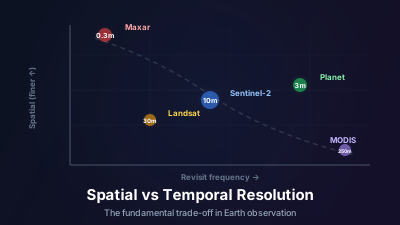
Quick Answer: Satellite imaging involves a fundamental trade-off: high spatial resolution (detailed pixels) typically means lower temporal resolution (less frequent revisits), and vice versa. A 30 cm commercial satellite may revisit every 3-5 days; Sentinel-2 at 10 m revisits every 5 days; MODIS at 250 m provides daily coverage. Constellations of small satellites (like Planet) attempt to break this trade-off. Choose based on whether your application needs detail or frequency.
A common request in satellite imaging is daily 1-meter imagery of one specific site — a construction project, a port, a stretch of road. The equally common assumption behind it is that satellites pass overhead every day anyway, so any of them could simply be asked for the picture.
They do. Just not the same satellite, at the same resolution, over the same spot, every single day. The gap between that expectation and orbital physics is the resolution trade-off.
The Physics Behind the Trade-Off
Imagine you're taking photos from an airplane. If you use a telephoto lens (high spatial resolution), you capture fine detail — but only a small area. To cover a larger region, you'd need more passes. If you switch to a wide-angle lens (lower spatial resolution), you capture a wider area per frame but lose the fine detail.
Satellites face the same constraint. A sensor designed to resolve 30-centimeter objects has a narrow field of view — perhaps a 15 km swath width. That narrow strip means the satellite needs many orbits to cover the same area that a wide-swath sensor captures in one pass.
Sentinel-2, with its 10-meter resolution, has a 290 km swath width. That wide coverage, combined with two satellites, achieves 5-day revisit at the equator. A commercial satellite at 30 cm resolution might only cover a 10-15 km strip, requiring deliberate tasking (pointing the satellite) to image a specific location.
Resolution Spectrum in Practice
| Satellite/Sensor | Spatial Resolution | Temporal Resolution | Swath Width |
|---|---|---|---|
| MODIS (Terra/Aqua) | 250 m – 1 km | Daily (global) | 2,330 km |
| Landsat 8/9 | 30 m (15 m pan) | 16 days (8 with both) | 185 km |
| Sentinel-2A/B | 10 m | 5 days (both satellites) | 290 km |
| Sentinel-1A/C | 5×20 m (IW mode) | 6 days (both satellites) | 250 km |
| SPOT 6/7 | 1.5 m (0.5 m pan) | Daily (tasked) | 60 km |
| Planet SkySat | 50 cm | On demand | 8 km |
| Maxar WorldView | 30 cm | 1–3 days (tasked) | 13 km |
The pattern is clear: as spatial resolution improves, temporal frequency drops and swath narrows.
When Spatial Resolution Wins
Some questions demand detail:
Infrastructure monitoring: Counting vehicles in a parking lot, measuring building footprints, detecting small-scale construction changes — you need sub-meter imagery. A 10-meter pixel would blend the parking lot with its surroundings.
Urban mapping: Distinguishing individual buildings requires 1–2 meter resolution. At Sentinel-2's 10 meters, a city block becomes a handful of mixed pixels.
Precision agriculture (field-scale): Identifying variation within a single field — which rows are stressed, where drainage is poor — benefits from 1–5 meter resolution. At 30 meters, those within-field patterns disappear.
Legal evidence: Satellite imagery used in court proceedings or insurance claims often needs the highest available resolution to be unambiguous.
When Temporal Resolution Wins
Other questions demand frequency:
Crop phenology: Tracking growth stages — germination, flowering, senescence — requires observations every few days throughout the growing season. Missing the flowering window by a week means missing the data entirely. MODIS or Sentinel-2 time series work well here.
Flood dynamics: Floodwaters can rise and recede within days. Daily or near-daily coverage captures the full extent and recession. Waiting 16 days between Landsat passes means potentially missing the peak entirely.
Fire monitoring: Active fire detection needs multiple observations per day. VIIRS on NOAA-20 and NOAA-21 provides this (Suomi NPP did too; NOAA ends its data distribution on November 1, 2026), albeit at 375-meter resolution. You can't resolve individual trees, but you can detect the fire.
Atmospheric events: Weather systems, smoke plumes, dust storms — these phenomena evolve hourly. Geostationary satellites provide 10–15 minute imaging at kilometer-scale resolution.
Breaking the Trade-Off: Constellations
The traditional trade-off between spatial and temporal resolution assumed a single satellite. Constellations change the equation by distributing coverage across many platforms.
Planet's Dove constellation (200+ satellites) achieves daily global coverage at 3-meter resolution. Each individual satellite isn't remarkable — it's the sheer number that makes daily revisit possible.
Capella Space is building a SAR constellation aiming for hourly revisit at sub-meter resolution.
The cost of constellation data varies significantly. Planet's daily imagery requires a subscription; it's not freely available like Sentinel or Landsat data.
The Practical Choice
When planning a project, work through three questions:
-
What's the smallest feature you need to detect? This sets the minimum spatial resolution. If you need to identify individual trees, you need sub-5m. If you need field-level patterns, 10–30m is fine.
-
How fast does the phenomenon change? Deforestation is detectable with monthly imagery. Flood extent changes daily. Crop stress evolves weekly. Match your temporal needs to the available data.
-
What's the budget? Free data (Sentinel, Landsat, MODIS) covers most research and monitoring needs. Commercial high-resolution data is necessary for specific applications but costs money.
Most of the time, freely available Sentinel-2 (10m, 5-day) data hits the sweet spot. It's detailed enough for field-level vegetation analysis and frequent enough for seasonal monitoring. When it isn't sufficient, that's when you start considering the higher tiers — and their associated costs.
Quick Reference: Choosing the Right Resolution
For the most common Earth observation use cases, here's a practical decision guide:
| Use Case | Minimum Spatial | Minimum Temporal | Best Free Option | Notes |
|---|---|---|---|---|
| Regional crop monitoring (field blocks) | 10–30 m | 5–10 days | Sentinel-2 | NDVI time series |
| Individual field precision management | 5–10 m | 5–7 days | Sentinel-2 (10 m) | Within-field variation needs ≤10 m |
| Flood extent mapping | 10–20 m | 1–3 days | Sentinel-1 (SAR) | Clouds defeated by radar |
| Wildfire active detection | 375 m | Twice daily | VIIRS (FIRMS) | Need frequency, not detail |
| Wildfire burn scar mapping | 10–30 m | Weekly | Sentinel-2 | After fire season |
| Urban construction monitoring | 1–5 m | 2–4 weeks | None free; Planet/Maxar | Sub-meter for small features |
| Deforestation detection | 10–30 m | Monthly | Sentinel-2 / Sentinel-1 | SAR for cloud-affected tropics |
| Volcano deformation | N/A (InSAR phase) | 6–12 days | Sentinel-1 | mm-level precision |
| Coastal change / shoreline | 3–10 m | Monthly | Sentinel-2 | Annual shoreline comparison |
| Large-scale land cover mapping | 10–30 m | Annual composite | Sentinel-2 / Landsat | Seasonal median composite |
The key insight: most environmental monitoring doesn't require sub-meter resolution. The common mistake is assuming that higher resolution is always better. A 10-meter Sentinel-2 pixel covers 100 m² — more than sufficient to detect stress, change, or classification differences at the field or ecosystem level. You only need sub-meter when the target feature is itself smaller than a few meters.
Combining Resolutions: Data Fusion
An increasingly common approach is to combine data from multiple sensors:
- Use Sentinel-2 for its spectral richness and consistent temporal coverage
- Add commercial imagery for occasional high-resolution snapshots at critical moments
- Incorporate MODIS/VIIRS daily data to fill temporal gaps
This fusion approach gives you the best of both worlds — temporal continuity from frequent, moderate-resolution sensors and spatial detail from occasional high-resolution acquisitions. It requires more sophisticated processing but delivers analysis that no single sensor could provide alone.
The resolution trade-off isn't a problem to solve — it's a design constraint to work within. Understanding it helps you choose the right data for the right question, rather than always reaching for the highest resolution available.

Remote sensing specialist with 10+ years in satellite data processing and AI. Founder of Off-Nadir Lab. Ph.D. in Informatics (Yokohama National University, 2026). Master's in Earth System Science and Technology (Kyushu University). Co-author, Remote Sensing Encyclopedia. More about the author →