SAVI: The Vegetation Index That Accounts for Bare Soil
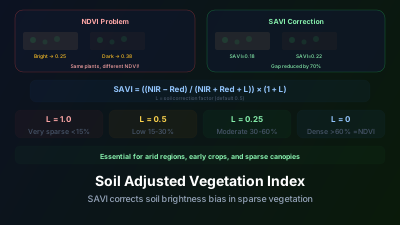
Quick Answer: NDVI overestimates vegetation in sparse canopies because bare soil between plants contributes to the spectral signal. SAVI adds a soil brightness correction factor (L) to the NDVI formula: SAVI = ((NIR - Red) / (NIR + Red + L)) × (1 + L). With L=0.5 as the standard default, SAVI removes a substantial part of the soil-brightness variation that NDVI leaves in, though how much it helps depends on how bright and how variable the soils in your scene are and on how sparse the canopy is. Use SAVI in arid/semi-arid regions, early-season crops, and anywhere vegetation cover is below ~40%.
The Soil Adjusted Vegetation Index (SAVI) exists because NDVI overstates vegetation wherever bare soil shows between plants; adding a soil-brightness term (L) makes sparse-canopy readings track plants rather than dirt. The ambiguity that motivates it is easy to state: across newly planted fields in a dry region, NDVI can return a narrow range of low values that appears to indicate uniform light vegetation cover, while the ground is actually a mix — some fields carrying healthy seedlings, others bare red sandy soil with virtually no green matter.
The problem was soil. The red, sandy soil had moderate NIR reflectance, pushing NDVI values upward even where no vegetation existed. NDVI was seeing dirt and calling it crops.
Why does NDVI struggle with sparse vegetation?
NDVI struggles with sparse vegetation because each pixel below roughly 40% cover mixes plant and soil reflectance, and different soils carry different spectral signatures. It works beautifully only where the canopy dominates the pixel — a mature wheat field or a tropical forest — covering the soil completely so NDVI reliably tracks vegetation density and health. Both bands it uses, red and near-infrared, report the soil as much as the plants when cover is thin.
But when vegetation is sparse — cover below about 40% — each pixel captures a mixture of plant and soil reflectance. The problem: different soils have different spectral signatures.
Dark soils (high organic content) have low red and low NIR reflectance. NDVI tends to underestimate vegetation over dark soils.
Bright soils (sandy, calcareous) have moderate red and moderate NIR reflectance. NDVI tends to overestimate vegetation over bright soils.
The same vegetation density can produce NDVI values that differ by 0.1–0.2 purely due to the underlying soil, which is large enough to completely confound any analysis in sparse-vegetation environments.
The SAVI Solution
Alfredo Huete published the Soil Adjusted Vegetation Index in 1988, specifically addressing this problem. The formula:
SAVI = ((NIR − Red) / (NIR + Red + L)) × (1 + L)
The addition of L in the denominator shifts the origin of the vegetation index, reducing the influence of soil background reflectance. When L = 0, SAVI reduces to NDVI. When L = 1, the index maximally corrects for soil effects.
How do you choose the L factor?
The standard recommendation is L = 0.5, which works well for intermediate vegetation densities. Push L toward 1.0 where vegetation is very sparse and toward 0 where the canopy is dense, since L sets how much soil-background correction the index applies. The optimal value depends on conditions:
| Vegetation Density | Recommended L | Scenario |
|---|---|---|
| Very low (< 15%) | 1.0 | Desert margins, newly cleared land |
| Low (15–30%) | 0.5 | Semi-arid rangelands, early crops |
| Moderate (30–60%) | 0.25 | Established croplands, open woodland |
| High (> 60%) | 0 (use NDVI) | Dense forest, mature crops |
In practice, most analysts use L = 0.5 as a universal default. The improvement over NDVI is worthwhile even without optimizing L — a substantial part of the soil-brightness variation is removed — though how much depends on how bright and how variable the soils in your scene are, and on how sparse the canopy is.
SAVI vs NDVI: A Concrete Example
Consider two adjacent pixels in a semi-arid landscape:
- Pixel A: Sparse shrubs on bright sandy soil. NIR = 0.30, Red = 0.18
- Pixel B: Same shrub density on dark clay soil. NIR = 0.22, Red = 0.10
NDVI calculation:
- Pixel A: (0.30 − 0.18) / (0.30 + 0.18) = 0.25
- Pixel B: (0.22 − 0.10) / (0.22 + 0.10) = 0.375
NDVI says Pixel B has 50% more vegetation. In reality, both have the same vegetation — the soil is the only difference.
SAVI calculation (L = 0.5):
- Pixel A: ((0.30 − 0.18) / (0.30 + 0.18 + 0.5)) × 1.5 = 0.184
- Pixel B: ((0.22 − 0.10) / (0.22 + 0.10 + 0.5)) × 1.5 = 0.220
SAVI narrows the gap from 0.125 (NDVI) to 0.036 (SAVI). The soil signal is substantially suppressed.
MSAVI: The Self-Adjusting Variant
The Modified SAVI (MSAVI2) eliminates the need to manually select L by calculating it automatically for each pixel:
MSAVI2 = (2 × NIR + 1 − √((2 × NIR + 1)² − 8 × (NIR − Red))) / 2
The formula looks intimidating but it's straightforward to compute. MSAVI2 adaptively adjusts the soil correction based on the amount of vegetation present in each pixel — applying more correction where vegetation is sparse and less where it's dense.
MSAVI2 often performs slightly better than SAVI with a fixed L = 0.5, particularly in landscapes with highly variable vegetation density. The improvement is most noticeable at the sparse end of the spectrum.
When should you use SAVI instead of NDVI?
Use SAVI whenever exposed soil influences the signal — vegetation cover below ~40%, arid and semi-arid sites, early-season fields before canopy closure, or scenes where soil types vary. Stick with NDVI where the canopy is closed, or when you need comparability with published NDVI thresholds and long time series. The decision is usually straightforward:
Use SAVI when:
- Vegetation cover is below ~40%
- The study area includes exposed soil (agricultural fields before full canopy closure — a common case in precision agriculture — rangelands, savannas)
- You're mapping vegetation in arid or semi-arid environments
- Soil types vary across your study area
- You need to compare vegetation density across sites with different soil backgrounds
Stick with NDVI when:
- Vegetation is dense and fully covers the soil
- You're working in forests with closed canopy
- Temporal comparison is more important than absolute accuracy (NDVI's longer heritage makes it more comparable across studies)
- You need to compare with published NDVI thresholds or datasets
SAVI Values in Arid and Semi-Arid Environments
For dryland monitoring with free Sentinel-2 imagery, the approximate values to expect (L = 0.5) for different land cover types are:
| Land Cover | SAVI (L=0.5) | Notes |
|---|---|---|
| Bare rock / desert pavement | 0.00–0.05 | Near-zero; no vegetation signal |
| Sandy desert (no vegetation) | 0.00–0.08 | Slightly higher than rock due to soil NIR |
| Desert shrubland (< 10% cover) | 0.06–0.15 | Sparse scatter of shrubs |
| Semi-arid savanna (10–30% cover) | 0.15–0.28 | Seasonally variable; peaks in wet season |
| Open dryland cropland (emergence) | 0.10–0.22 | Heavy soil influence even with seedlings |
| Rangeland / dry grassland (30–50% cover) | 0.25–0.38 | Useful monitoring range for SAVI |
| Rain-fed cropland (mid-season) | 0.35–0.50 | Canopy becoming established |
| Irrigated cropland (peak season) | 0.50–0.65 | Transitioning toward NDVI range |
The practical monitoring zone for SAVI is roughly 0.10–0.45. Below 0.10, you're in noise territory where soil variability dominates. Above 0.45, NDVI has adequate sensitivity and the soil correction advantage diminishes.
A useful field calibration check: take a sample of 5–10 in-situ measurements of vegetation fractional cover in your study area. If any location with < 35% cover shows unexpectedly high NDVI values (> 0.35), that's a signal you need SAVI — the soil is contaminating the optical signal.
Beyond SAVI
The vegetation index literature is enormous, with dozens of indices designed for specific conditions:
- OSAVI (Optimized SAVI): Uses L = 0.16, optimized for moderate-to-high vegetation. Better in agricultural settings with some soil visibility.
- TSAVI (Transformed SAVI): Uses soil line parameters derived from the specific image, making it theoretically optimal but requiring additional calibration.
- EVI (Enhanced Vegetation Index): Adds a blue band correction for atmospheric effects alongside soil correction. It is produced operationally as part of NASA's MODIS vegetation index products (MOD13), which ship NDVI and EVI side by side precisely because no single index suits every canopy.
Each has its niche, but for the common scenario of "I have sparse vegetation and NDVI is giving me unreliable numbers," SAVI with L = 0.5 solves the immediate problem with minimal complexity.
The existence of these indices reflects a broader truth about remote sensing: the "best" approach depends on your specific conditions. There's no universal vegetation index, just as there's no universal satellite — choosing the right index for the job is its own skill. That skill is in matching the tool to the problem, and knowing when NDVI isn't enough.

Remote sensing specialist with 10+ years in satellite data processing and AI. Founder of Off-Nadir Lab. Ph.D. in Informatics (Yokohama National University, 2026). Master's in Earth System Science and Technology (Kyushu University). Co-author, Remote Sensing Encyclopedia. More about the author →