
Satellite Monitoring of Mining Operations: Compliance, Environment, and Safety
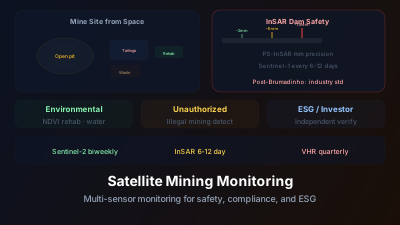
Quick Answer: Satellite monitoring provides independent oversight of mining operations at every stage: exploration (identifying geological indicators), active mining (tracking pit expansion, overburden removal, and production rates), environmental compliance (vegetation rehabilitation, water quality, dust extent), and safety (tailings dam deformation via InSAR at mm/year precision). After the Brumadinho tailings dam collapse (2019, 270 deaths), InSAR monitoring of dam stability became industry standard. Satellite monitoring is particularly valuable for remote mines in developing countries where regulatory inspection capacity is limited. Sentinel-2 provides free biweekly monitoring; commercial VHR and InSAR provide detailed assessment.
On January 25, 2019, a tailings dam at the Córrego do Feijão iron ore mine in Brumadinho, Brazil collapsed without warning, releasing 12 million cubic meters of mining waste that killed 270 people. Post-disaster analysis of Sentinel-1 InSAR data found ground deformation that was not consistent with ordinary consolidation settlement, and an accelerating rate of deformation from about late October 2018 — a warning sign that, had it been monitored in real time, might have triggered evacuation.
The Brumadinho disaster transformed the mining industry's approach to satellite monitoring. What was previously a compliance checkbox became a safety imperative.
What can satellites see at a mine site?
Essentially the whole operational footprint: pit boundaries and their expansion, waste rock dumps, tailings impoundments and their water levels, processing plants, stockpiles, and haul roads. Optical imagery tracks the visible changes; InSAR adds what optical cannot see — millimeter-scale ground deformation of dams and dumps.
Open Pit Progression
Open-pit mines expand over time — deeper and wider. Satellite monitoring tracks:
- Pit boundary expansion: Monthly comparison of pit extent from optical imagery
- Bench advancement: Individual mining benches visible at VHR resolution
- Depth estimation: Shadow analysis and stereo imagery estimate pit depth changes
- Volume calculation: DEM differencing between epochs quantifies material removed
Overburden and Waste Rock
Material removed to access ore creates waste dumps:
- Dump expansion: Growing waste rock dumps visible as expanding elevated features
- Dump stability: InSAR monitors waste dump deformation that could indicate instability
- Rehabilitation progress: NDVI monitoring tracks vegetation establishment on reclaimed dumps
Tailings Storage Facilities
Tailings — fine-grained waste from ore processing — are stored in large impoundments:
- Dam height and freeboard: The distance between the water/tailings surface and the dam crest is a critical safety parameter. Satellite altimetry and optical imagery estimate freeboard.
- Pond extent: Water coverage within the tailings facility indicates operational status and capacity
- Beach length: The distance from the dam crest to the pond edge — longer beach = lower risk
- Seepage indicators: Vegetation anomalies downstream of dams may indicate seepage
Processing and Infrastructure
- Crushing and processing plant construction/expansion
- Conveyor belt and road network changes
- Stockpile volumes (ore, concentrate, waste)
- Port and rail loading facility activity
How does InSAR monitor tailings dam safety?
InSAR compares the radar signal phase between repeat passes of the same satellite, converting phase shifts into surface displacement measurements at millimeter-per-year precision. After Brumadinho, InSAR monitoring of tailings dams became an industry standard and, in some jurisdictions, a regulatory requirement — the technique detects the slow, accelerating movement that often precedes structural failure, and it is explained in depth in our ground subsidence InSAR guide.
How It Works
InSAR measures surface displacement of the dam structure:
- Persistent Scatterer InSAR (PS-InSAR): Tracks individual measurement points (typically dam crest infrastructure, concrete structures) at mm/year precision
- Distributed Scatterer InSAR: Provides broader spatial coverage over the dam surface
- Temporal frequency: Sentinel-1 every 6-12 days; commercial SAR (TerraSAR-X, COSMO-SkyMed) every 1-4 days for critical facilities. Free Sentinel-1 scenes are archived and distributed by the Alaska Satellite Facility, whose DAAC "specializes in synthetic aperture radar (SAR) data collection, processing, archiving, and distribution"
What Displacement Indicates
Normal behavior: Tailings dams settle gradually under their own weight. Expected settlement rates depend on dam type and age — typically a few mm to a few cm per year.
Anomalous behavior: Acceleration of displacement, displacement in unexpected directions, or differential displacement (one part of the dam moving differently from adjacent parts) may indicate:
- Foundation weakness
- Internal erosion (piping)
- Overloading
- Liquefaction precursors
The Challenge
InSAR detects displacement but doesn't diagnose the cause. A measured displacement anomaly requires geotechnical interpretation to determine whether it indicates a safety concern or normal operational behavior. InSAR is a screening tool, not a standalone safety assessment.
Environmental Compliance Monitoring
Vegetation and Rehabilitation
Mining permits typically require progressive rehabilitation of disturbed areas:
- NDVI monitoring: Tracks vegetation establishment on reclaimed land over time
- Baseline comparison: Current vegetation condition versus pre-mining or reference conditions
- Compliance verification: Independent satellite evidence that rehabilitation commitments are being met
Water Quality
Satellite water quality indicators downstream of mining operations:
- Turbidity: Increased suspended sediments in rivers and lakes downstream of mines
- Acid mine drainage: Color changes in water bodies receiving acidic runoff (iron oxide coloring)
- Tailings discharge: Turbidity plumes from tailings facility discharge points
Dust and Air Quality
Mining operations generate dust:
- Dust plumes: Visible in satellite imagery during dry, windy conditions
- Dust deposition: Changes in surrounding vegetation health potentially attributable to dust deposition
- Extent mapping: Identifies affected areas beyond the mine boundary
How is unauthorized mining detected?
The approach is a spatial comparison: map where mining is permitted, then flag new ground disturbance appearing anywhere else. Artisanal and small-scale mining (ASM), often unregulated, is a significant issue in many countries, and satellite change detection is frequently the only surveillance tool that scales to entire regions.
Detection approach:
- Map known, permitted mining areas
- Use change detection to identify new ground disturbance outside permitted areas
- Classify disturbance patterns characteristic of mining (excavation pits, processing areas, access roads)
- Flag for regulatory investigation
Sentinel-2 at 10m resolution detects medium-scale unauthorized mining. VHR imagery resolves individual artisanal mining pits.
Illegal mining in protected areas: Satellite monitoring detects mining encroachment into national parks, indigenous territories, and conservation zones — often the first evidence that unauthorized activity is occurring.
ESG and Investor Applications
Environmental, Social, and Governance (ESG) assessment increasingly relies on satellite data:
Independent verification: Satellite monitoring verifies company-reported environmental performance against observable reality. Is the mine actually rehabilitating as reported? Is the tailings facility operated within approved boundaries? This is the same evidence model used in environmental compliance monitoring more broadly.
Supply chain due diligence: Investors and downstream companies verify that mines in their supply chain aren't associated with illegal deforestation, water pollution, or other environmental violations.
Benchmark comparison: Compare environmental performance across mines in a portfolio or across competitors.
Reading InSAR Displacement on a Tailings Dam
There is no universal displacement rate that means "safe" or "about to fail". Published alarm thresholds are set per facility by the geotechnical engineer of record, because what counts as anomalous depends on the dam's construction method (upstream, downstream, centreline), its age and stage of raising, the tailings' consolidation history, the foundation, and the phreatic surface. A rate that is unremarkable on a young, actively raised downstream dam can be a serious signal on a closed upstream one.
What InSAR contributes is therefore not an absolute number but a shape: the departure from that facility's own established baseline. Three patterns matter more than magnitude:
- Acceleration. A displacement rate that is increasing, rather than decaying the way consolidation settlement does.
- Direction. Movement that is not the downward, gradually slowing settlement the design predicted.
- Differential movement. One sector of the dam moving differently from its neighbours, which points to a localised mechanism rather than global consolidation.
Pre-collapse signals from case studies: Retrospective InSAR analyses of failed facilities have repeatedly recovered precursory signals in archive data that nobody was watching in real time. At Brumadinho, an analysis of Sentinel-1 data covering the months before the January 2019 collapse found deformation that was not consistent with consolidation, accelerating from about late October 2018 following increased rainfall. Comparable retrospective work has been published for other tailings failures, including Fundão (Brazil, 2015) and Mount Polley (Canada, 2014).
The Brumadinho lesson: the pre-failure movement was within what Sentinel-1 InSAR could measure, from free data that already existed. The missing element was not the technology but the operational system around it — continuous monitoring with automatic alerting, and geotechnical expertise to interpret the displacement as a warning rather than as normal settlement. Facility-specific displacement thresholds tied to escalation protocols are now a common element of tailings management practice.
Operational Intelligence
Production estimation: Regular satellite monitoring of pit progression, stockpile volumes, and shipping facility activity provides independent estimates of mine production — valuable for commodity market analysis and investment decisions.
Competitor monitoring: Mining companies monitor competitor development projects — construction progress, timeline adherence, and capacity estimates — from satellite imagery.
Practical Implementation
| Application | Sensor | Resolution | Frequency |
|---|---|---|---|
| Pit expansion tracking | Sentinel-2 | 10m | Biweekly |
| Detailed site assessment | WorldView/Pléiades | 0.3-0.5m | Quarterly |
| Tailings dam stability | Sentinel-1 InSAR | 5×20m | 6-12 days |
| Critical dam monitoring | TerraSAR-X InSAR | 1-3m | 1-11 days |
| Environmental compliance | Sentinel-2 + Landsat | 10-30m | Monthly |
The combination of free Sentinel data for routine monitoring and targeted commercial imagery for detailed assessment provides cost-effective mine site oversight. For tailings dam safety — where the consequences of failure are measured in lives — the investment in high-frequency InSAR monitoring is small relative to the risk being managed.
Mining sits within a broader family of facility-level surveillance: industrial site monitoring covers the same methods applied to refineries, ports, and chemical plants, and at the exploration end, iron oxide and clay mineral mapping shows how multispectral ratios identify the alteration zones that mines are built on. To run this kind of repeat observation over a specific site, start with a polygon in satellite area monitoring.

Remote sensing specialist with 10+ years in satellite data processing and AI. Founder of Off-Nadir Lab. Ph.D. in Informatics (Yokohama National University, 2026). Master's in Earth System Science and Technology (Kyushu University). Co-author, Remote Sensing Encyclopedia. More about the author →